
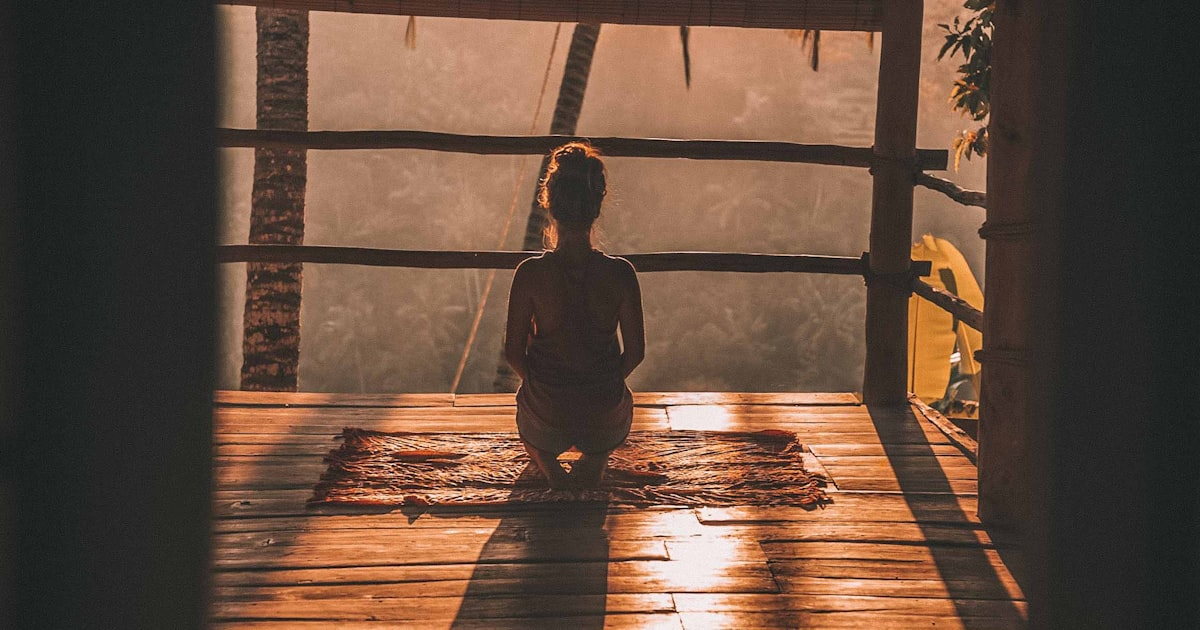
Reflections on breath, impermanence, and learning to stay with what hurts.
For most of my life, yoga was something I practiced inconsistently.
It was something I returned to when I wanted to feel healthy, calm, or grounded. I would practice for a few weeks, feel good, and then drift away from it again. I enjoyed yoga, but I didn’t truly live it or embrace all its roots or all that it had to offer.
Over the past year, that relationship changed completely.
Yoga slowly became something woven into my everyday life. Even if it was just ten minutes of movement on my bedroom floor or a few moments of intentional breathing before bed, it became something steady that I could return to, no matter the circumstances.
At first, I noticed the physical changes. My body felt stronger. My balance and posture improved. My breath became deeper and more controlled.
But the most meaningful changes weren’t physical.
They were emotional.
I began to notice that I felt calmer throughout the day. Less reactive. More present. When something stressful happened, I found myself instinctively returning to my breath rather than getting pulled immediately into anxiety loops that would take over my body and mind.
Without realizing it, yoga was creating a new space inside of me.
At the time, I didn’t know how important that space would become.
The power of shared practice
As my practice deepened, studio classes started to take on a new meaning for me.
Practicing yoga in a room full of people creates a unique kind of connection. Even when no one speaks, there is a shared intention in the space. Everyone is there to move, breathe, and show up for themselves in some unique capacity.
During a time in my life when I was carrying a lot emotionally, that shared energy mattered more than I expected.
Being surrounded by others who were also practicing, breathing, and simply being present made me feel less alone. There was a quiet sense of support in the room. Not through conversation, but through presence.
Each class generally carries a theme, and some often resonate deeply with where I am emotionally. One class in particular focused on the Japanese philosophy of Kintsugi, the idea that broken things can be repaired with gold, and that the cracks themselves become part of the beauty.
That idea stayed with me.
It reframed the way I thought about emotional pain. Instead of something that needed to be hidden or quickly fixed, it could be something that shaped who we become.
the day everything shifted
I remember the yoga class clearly. The day I came to the realization my mom’s passing was near. The tension and pain in my body felt unbearable. I could barely keep myself composed driving there, but something in me knew I needed to move. Not to escape. To breathe.
The theme of the class was change. Adaptability. Letting go of the illusion of control.
The timing of it all was laughable.
There I was, trying to hold my life together, and the teacher was calmly asking us to soften into discomfort. To stop gripping. To trust what was unfolding.
I could barely hold back tears in each pose. My chest felt tight. My jaw clenched. Every pose felt like it required more honesty than strength.
But something subtle happened.
Instead of spiraling into future fear, I stayed with the breath. Inhale. Exhale. Inhale. Exhale. Over and over again. Not because I was calm. Because it was the only thing I could control.
And eventually I realized I didn’t need to control anything.
I just needed to feel it.
Yoga, in that moment, was not flexibility or discipline. It was a container. A place where my body could experience grief before my mind had language for it. Where I could be cracked open without falling apart.
When class ended, I went home and cried in a way that felt like a renewal. No longer suppressed, just wholeheartedly feeling the depth of raw emotion. Afterward, I sat quietly. Breathed. And then I got up and went to visit my mom.
In that moment, I realized yoga had given me something incredibly important. It had taught me how to stay present with emotions that felt almost too big to hold. Even though this profound day for me was over a year ago, the depth I felt still resonates within me like it was yesterday.
Breath is the practice
As my practice deepened over time, something became very apparent to me.
The breath isn’t just a complimentary part of yoga.
In many ways, it is the practice.
Before studying yoga and its philosophy more seriously, I thought that the breathing techniques were simply a way to calm down and ease into the postures. But over time I began to understand why breath sits at the center of the tradition. Breath is what links the body and the mind, it acts as a bridge between what we can control and what we cannot.
In this time of my life, it felt as if almost everything was out of my control. I couldn’t slow time. I couldn’t take away the pain for myself or for my family. The mind wants to fight that. It searches for answers, for alternatives, for anything that makes the situation feel less final.
But, the breath doesn’t seek answers. It simply asks you to be here now, in the body.
This is where breath illuminated itself at the center of yoga. not as something I was controlling, but as something already moving through me, steady and rhythmic, regardless of what I was feeling.
It continued whether I resisted or softened, whether I understood what was happening or not. And in that, there was something both grounding and confronting. Life was still moving through me, even as I was faced with the reality of losing someone I loved.
I began to notice that the intensity of what I was feeling wasn’t just coming from the moment itself, but from the tension of trying to be somewhere else, trying to escape what was already here.
The breath made that impossible.
Each inhale, each exhale, brought me back into direct contact with the present. Not as an idea, but as something physical, something undeniable. There was a kind of quiet intelligence in that rhythm, something I could attune to when everything else felt uncertain.
And with that came something new. An alteration.
Not into peace, not into resolution, but into a deeper capacity to hold what I was experiencing. The breath didn’t take the grief away, but it created space around it. Enough space to feel it fully, without being overtaken.
What the practice is actually for
It’s easy to associate yoga with a controlled environment. A designated space, maybe music playing, a teacher guiding you through something intentional and contained. You know exactly when it starts and when it ends.
Real life doesn’t work like that.
In life, grief or emotion don’t arrive when you’re ready for it or expecting. They can show up in the middle of ordinary moments. Driving, standing in the kitchen, sitting in a room that suddenly feels too quiet. There’s no sequence to follow, no cue telling you what to do next.
his is where yoga stops resembling a practice and begins to show its function.
On the mat, discomfort is framed. It has a beginning, a shape, and an end. You can adjust your position, come out of a posture, or wait for the next transition. Outside of that environment, there is no transition. The sensation remains.
What yoga develops is not flexibility, and not even calm, but the ability to remain inside an experience without immediately trying to change it.
That ability is conditioned through breath.
Not as a soothing technique, but as a physiological regulator. The breath directly influences the nervous system, altering heart rate, tension, and stress response. It creates a pause between stimulus and reaction. Without that pause, the mind moves to avoid, suppress, or control. With it, there is the possibility of staying.
This is why breath holds a central place in the tradition. It is not symbolic. It is functional.
And in moments of grief, that function becomes unmistakable.
It’s never supposed to feel better, but when you recognize what exists without force, it inherently does.